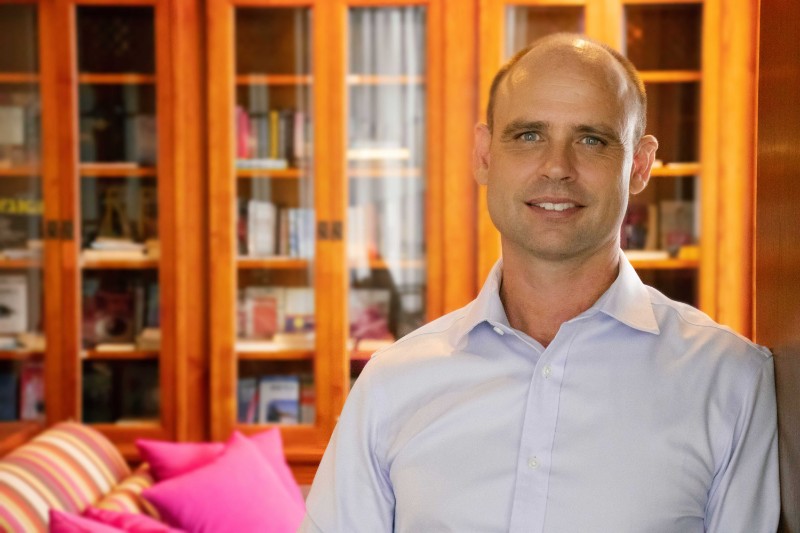
The Henosis Interview hands the floor to the practitioners in this network.
I've known Todd Peyton for years, right back to the start of the hypnosis journey. This field has no shortage of good energy. What Todd has is grounded integrity, which is rarer, and a great deal more useful when somebody in the room is coming apart.
He's an American psychotherapist, over twenty years of clinical and facilitation work, in trauma, emotional resilience and the connection between body and mind. He's sat with American veterans carrying PTSD home from the wars, and he's sat with professionals and leaders under serious stress and burnout. Jungian psychology, somatic practice and Kundalini yoga, all of it built on nervous system safety before anything else gets touched.
In all the years I've known him I've never seen him perform for a room. He just gets to work.
He took a group of us through a kidney kriya. Most demanding practice I've ever run in that room, and the most sacred, and it is tiring, and everyone who did it knows it. Afterwards we talked.
Cameron: Before we went in, you gave the purpose of Kundalini in one line. Say it again.
Todd: The whole purpose of Kundalini is to develop consciousness and free will. Consciousness and free will. All of these exercises are just preparing the stage for you to become more aware of your body, your emotions, your thoughts, your intuitions, and your entire personality.
This is definitely coming from another culture, so there might be a bit of a culture shock. I just ask that you keep an open mind, enjoy it, and if you decide to go into the practice in more detail, what we're doing is going to start to make more and more sense.
Cameron: How long have you been practising?
Todd: I've been involved in mind-body exercises for pretty much my adult life. Starting with Tai Chi and Qigong, and then that moved into Vipassana meditation. I had ordained as a Buddhist monk for about seven years, off and on. Then I got involved in Hatha yoga. I was working for the US military for about eight years and every place I was at, they always had Hatha yoga.
And then I went through a personal crisis in my life and I didn't have the necessary tools. Kundalini yoga was somewhere in the back of my mind, so I looked it up and I began training, and it was exactly what I was looking for.
You can't solve body problems through your head. You have to get into the body, and this practice is amazing for gradually building up an embodied consciousness. And it starts to flow into multiple areas of life. Not only are you developing a greater relationship with your own being, with your own emotions, your own thoughts, your own energy, your own intuitions, spirit, soul, your interpersonal relationships also go through a gradual transformation. And your identity in whatever professional career you're in, that begins to expand too.
It's a holistic, integrative practice with direct application to anything that you're seriously concerned about in your life.
Cameron: You started us on the soles of the feet. I'd have guessed anywhere else. Why there?
Todd: Because we were working on the kidneys. On the sole of your foot, in Chinese medicine, is what's called the kidney one point. It's the root point and it connects directly with the kidneys. It's also the point where energetically you are connected to the earth.
Then we come up to the pelvis, and the first three chakras. Chakra one is in the anal region, chakra two is in the sexual organs, chakra three is the navel point, three fingers beneath your navel and about a centimetre in. The navel point is the energetic centre of the body.
Then the heart, shoulders back and dropped, opening that space. Then the neck, chin slightly down and in, which opens up the back of the neck. We're trying to open the entire spine from the sacrum all the way up into the brain stem, to allow energy to flow up and down. That's why posture matters.
Cameron: One of the group was in real crisis while we were doing this. Her father in hospital, her mother in a nursing home, and she was too sick to visit either of them. What do you give somebody standing in that?
Todd: You're in crisis mode. And it's important, as you're going through this, to reserve some space for yourself.
Very important to get into a place where you don't have to worry about mum and dad. They're there. They're always going to be there. That problem isn't going away. However, to generate a practice where you can step into it and feel like you don't have to take care of anybody else, you're just going to be taking care of you, however that happens.
So if you come into Kundalini, or any type of meditation that fits that bill, it's taking care of you. Creating a sacred container just for you.
Cameron: Somebody asked about alternate nostril breathing. Your answer went somewhere I didn't see coming, so take us through it.
Todd: There are known physiological responses to how you breathe.
If you cover your right nostril and breathe in and out through the left, you're focusing on the left side of the body, which is the parasympathetic system. So when you engage it, it's going to calm you down. In yogic philosophy it's also called the mother channel, or the moon channel. It's a feminine channel. So if you do this, especially in a difficult family situation, you can give reverence to, or process, feelings that belong to your mother and your relationship to your mother.
Then you switch to the other side. The right nostril is the sympathetic system, which is going to recharge you and bring you more energy, however in a more relaxed place. The right channel is known as the sun channel, the father channel. You can start processing your experiences and feelings around your father in that space too.
Centering is you. Bringing left and right together is where you are in the centre.
Cameron: Then the pineal gland, because that one rearranged how I think about anxiety.
Todd: The pineal gland is the master gland that controls the hormonal and endocrine systems. Anxiety is being created by your pineal gland, and your pineal gland takes its cue from the quality of your breath.
So as you breathe, you're informing safety and well-being to the pineal gland. And then that cascades throughout the entire body.
Cameron: You closed by having everybody put their forehead on the ground.
Todd: That seals the practice. It's also symbolic of paying reverence to yourself, to the teacher within you, and to your efforts. Everything you put into being here.
Cameron: Last one. What does this practice actually look like after decades of it?
Todd: One of my teachers in Bangkok is in her mid-eighties. She generates so much power and energy even at that age, and young people who come to take her class cannot keep up with her.
Most conversations I have in this field are about the ceiling. How high can you go, how far out can you get, what's on the other side of it. Todd talks about the floor, and he'll keep talking about the floor. Nervous system safety, then embodied consciousness, and he stays relaxed about whatever comes after that, because it tends to arrive on its own.
Then there was the soul in real crisis, live, in front of a group. He could have handed her a teaching. What he gave her instead was permission to put everybody else down for a while.
I'd take that over a decade of good energy.
Todd B. Peyton, MA, LPC is an American psychotherapist working with trauma, somatic practice, Jungian psychology and Kundalini yoga, and is the protocol lead on the Asclepian Method. Find his profile in the Henosis directory.
This conversation has been condensed and lightly edited for reading. Todd's words are his own. Nothing here is medical advice, and a strong pranayama practice is not appropriate for everyone. Work with a qualified teacher.