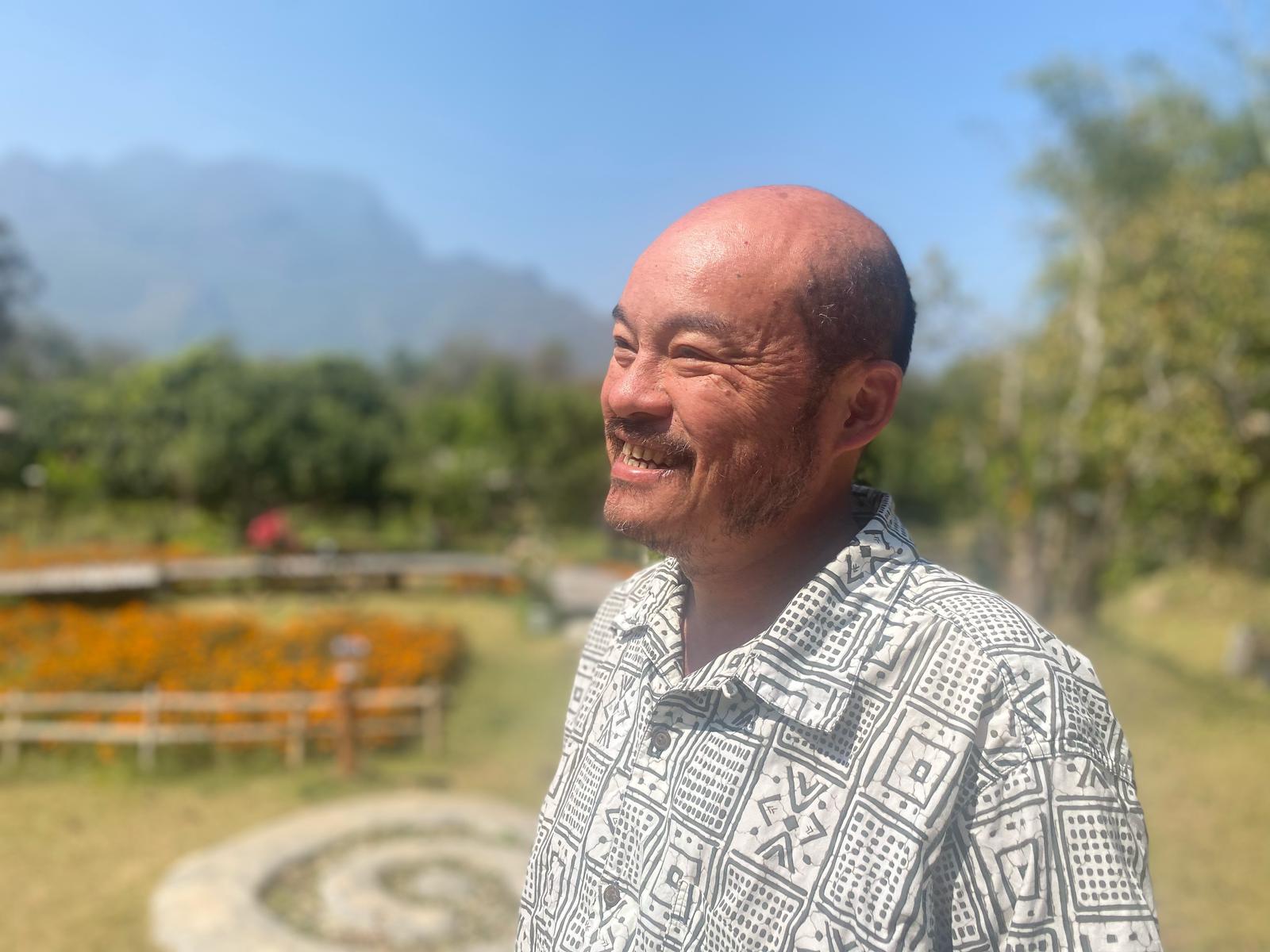
The Henosis Interview hands the floor to the practitioners in this network. This one is with a man who works with the dead for a living, and who is the least mystical human in the room every time he does it.
Thirteen years ago Isao Kato walked away from the corporate world with no plan, other than a quiet knowing that something in his life was out of alignment. He wasn't chasing visions. He'd never taken a psychedelic. A close friend invited him to a plant medicine ceremony in Taiwan, and something in him said yes.
His first journey was uneventful, and honestly a bit of a let-down. Then everything changed during the second half of his long-term training, when, without drinking anything, without an altered state of his own making, he found himself suddenly surrounded by roughly thirty dead spirits.
He means that literally.
From there he learned to talk with the dead, to move through the ether, and to help souls who are stuck or confused find their way on. That's the job now. Entity extraction, soul retrieval, house clearing and psychopomp work, for clients all over the world, me included, and a good number of my clients too. He trained through the Foundation for Shamanic Studies, he's listed in their practitioner directory, and he now runs a three-year shamanic healing training of his own.
Isao and I were introduced here in Chiang Mai. We went for a walk, got some food, and he talked about the conversations he has on the ethereal plane the way you'd talk about your working week. No mystery in it, no ego on it. I walked home thinking, everyone needs to hear this.
He also doesn't much like the word spiritual, which is exactly why I trust him.
Cameron: Start with what you actually practise, because when I hear shamanism I still picture one thing and I doubt it's yours.
Isao: There are roughly two types of shamanism in the world today. One is plant medicine, drinking the essence of some plants, maybe San Pedro, maybe ayahuasca, and then you're taken into the world of non-physical beings. The other type uses drums and rattles, using sound to put us into a state between waking and sleeping. The practitioner in that state enters the world of non-physical beings, while still having a clear consciousness in the waking world. It's quite similar to a lucid dream, where you realise you're in a dream and you can explore it freely.
The shamanism I practise is that one. Drums and sound, in a lucid state.
Within that, there's a specific branch called psychopomp, which is the practice of meeting the dead spirit and helping them move on. That's what I do.
Cameron: Why the drum? It shows up everywhere in the world, in cultures that never met.
Isao: In the days before organised religion, tens of thousands of years ago, when there were no means to communicate far away, when we were patches of isolated communities all over the world, they practised the same method of using sound to induce a certain state.
And when I say sound, it isn't elaborate music. It's a monotonous sound at a certain frequency. Dun, dun, dun. That's it. Many tribes found they were taken into a certain state of mind just by the sound. I believe it isn't an elaborate technique. It's something in nature, in all of us as living beings, that responds to that frequency.
In the olden days, communities relied much more heavily on the environment they were in, whether savannah or Amazon or jungle or beach. They had to listen and tune in to what goes on in nature much more than we do. And when you're paying attention, the so-called spirits, who are just beings in the non-physical world, just like us, they know you have been listening. So they respond. Someone is listening, someone is willing to respond.
Cameron: So what actually happens after we die?
Isao: From a shamanic perspective, it's as if this world we live in, the physical world, is a gigantic dream that we dream from the other side. The other side means where we came from, even before we were born.
So it's as if we birth ourselves into this human form, into this physical world, in this big dream bubble. And then when we complete our life here, the dream is over. We are waking up on the other side.
That's a cycle. In some traditions they might call it reincarnation. I decided not to borrow other words and just trust my experience, and my experience tells me it's similar to living in a huge dream. So when we die, then we wake up.
Cameron: And some don't wake up.
Isao: Some stay. If the soul is staying really close to where we live, they might appear as ghosts. No physical body, but a shape you can still see. Or someone might say, my friend passed away a few months ago and I still feel he is hanging out somewhere there, I just don't see anything.
My job is to tap on their shoulder and say, yes, you are not exactly where you think you are, why do we not move on.
Cameron: Give me an example. What does that actually do to the living?
Isao: Without giving too many details, because confidentiality is everything.
One type happens commonly. A mother or father passes away and doesn't go back to the source. Instead they hover around their kids. I had a client who said, no matter how many times I try, I never seem to have a steady relationship, something always happens and I always end up breaking up, and I know that isn't what I want.
So I went in, and sure enough, her mother, who died several years ago, was hanging over her shoulder, watching what she was doing. And her message was, I'm here to make sure my daughter never gets caught by a bad man.
The mother didn't have a bad intention from her perspective. She was just trying to protect her daughter. The one thing about that spirit is that they lose the bigger perspective. For one thing, the mother didn't even know that she had died.
The other type is a spirit completely merged into a living body. In that case the living person often doesn't notice at all, because if your body has felt heavier than usual for twenty years, you don't know you're carrying extra weight. It's just who you are. And in many cases the dead spirit stays because our vibrations are similar. Maybe we have a short temper, and there's a spirit who was also easily agitated when they were living, who finds something similar in vibe and comes in. They might make our agitation slightly worse, and they might also stop us from becoming less agitated, because they're always there.
Cameron: Let me put mine on the table, because it's a good picture of what this actually looks like.
Frances Carrington caught something on my face. You caught the same thing, separately. Before that I'd been riding my scooter around Chiang Mai and my road rage had gone up, my destructive thoughts about other humans had gone up, to the point where I caught myself and thought, why am I so angry right now?
So I cancelled the entire following day of meetings and came to you. And it turned out not to be an entity at all.
Isao: In your case, it wasn't a dead person. It was a part of you, let's say your inner child being isolated. So it needed to be brought back into your collective family, your inner family.
And on anger, there is no bad emotion. We feel uncomfortable, however every emotion is justified. Every emotion has its place in us. When a certain emotion is rejected, the only way for that emotion to express itself is to be more of that emotion.
So if you refuse to get sad, at some level you get extremely sad, because the sad energy needs to say, I exist. It gets sadder. And in your case, if you push away your anger...
That was happening. That wasn't an external dead person coming in. However, if you continued that angry way for long enough, surely someone with that anger energy might get attracted to you.
Cameron: Do the beings in the upper and lower worlds ever have their own agenda?
Isao: Both upper and lower world, they're there to help us. It isn't that there's a universal rule that says so. It's more from my experience. I've journeyed thousands of times. I've yet to find a being completely in the upper or lower world who had ulterior motives for us. I've yet to see one.
However, I've seen plenty of beings in the middle world, with physical body and without physical body, with not so nice motivations.
Cameron: Then why do we get put here at all, if we forget everything on the way in?
Isao: It's choice. God made a choice to give up his own choice.
Cameron: I want to ask you about suicide, because it's one of the things we're usually not allowed to talk about honestly.
Isao: Most people who take their own life don't do it because they want to die. They do it because they want to live, and they couldn't find a way to do that. There's this, I wanted this so much in my life and I couldn't get it, there's no way out, there's no option, I don't have any choice. However the wanting in the first place is still there. So they tend to stay easily.
There's no hard rule, though. There are also souls who go, and the next moment they're on the other side saying, oh my goodness, that was a quick move, and I'm so happy I did that. And the reverse happens too. Someone who had an incredibly lucky life, full of love and peace, and after they die somehow they get stuck in some other way.
It's as if there's a human life that we understand, and there's a soul that we don't understand, still working with us at that level.
Cameron: Do they regret it?
Isao: So far, no. I've found souls who say it was part of the deal, and souls who say it was a surprise. Still no regret.
Cameron: What's the one thing you'd have everyone reading this do?
Isao: I should not be saying this as a so-called spiritual practitioner, and I don't like that word spiritual, however it's best to start with your physical body.
We are beings that live in the physical world, and many of us, including probably me, tend to focus on escaping from this physical world, having greater access to the non-physical side, love and light and so on. That's fine. However everything, by design, starts from a physical body.
So do you want spiritual hygiene? Forget spirituality first. Make sure you have a healthy body and a somewhat healthy habit. I'm not talking about going vegan right now. I mean the habit that works for you, and where you feel you're in your body. And then, okay, this feels like me.
That's the best way to have spiritual hygiene.
That answer stopped me.
I'd asked the most experienced practitioner of the unseen I've ever met, a man who talks with the dead on a daily basis, for the one thing he'd have you take from a conversation about death and the afterlife. He said start with your body.
I've thought about that more than anything else he told me. Every practitioner I trust in this work eventually points the same direction, and it's downwards. Into the ground. Into the body you're already sitting in. The unseen isn't going anywhere, and it'll still be there once you've slept properly and eaten something.
Isao Kato is a Japanese shaman and psychopomp, thirteen years into shamanic healing and divination, working with drum and rattle. Entity extraction, soul retrieval, guardian spirit retrieval, psychopomp work and house clearing, in person, over video, or fully remote. He is nomadic across Asia. Find his profile in the Henosis directory.
This conversation has been condensed and lightly edited for reading. Isao's words are his own. Nothing here is medical advice. If you are struggling with thoughts of suicide, please reach out to someone today: Lifeline Australia 13 11 14, Samaritans UK 116 123, or 988 in the US and Canada.