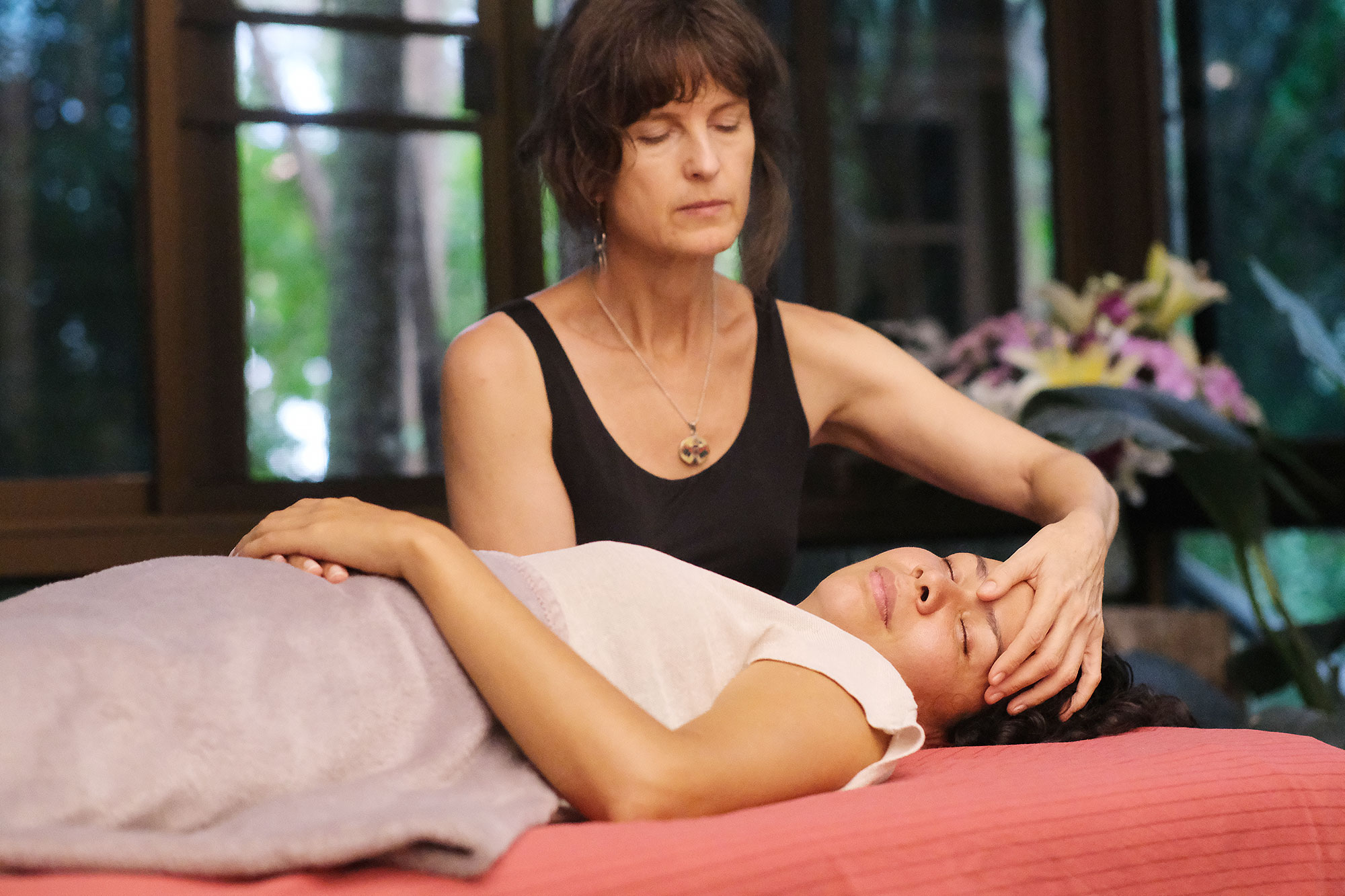
The Henosis Interview hands the floor to the practitioners in this network and lets them speak for themselves. First up, one of the humans who has most changed how I work.
Frances Carrington has been practising craniosacral work since 2011, these days out of Chiang Mai. She holds a BA in Osteopathy from the National University of Medical Sciences in Madrid, she's certified in Visionary Craniosacral Work through the Milne Institute where she trained directly with Hugh Milne, and she's a Registered Biodynamic Craniosacral Therapist with the Pacific Association of Craniosacral Therapists. That's the part that fits on a website.
The rest of it is stranger and a lot more interesting. Eighteen years in India. Humanitarian work with Tibetan refugees. Somewhere north of thirty Vipassana retreats, and finishing a single one is considered a feat of discipline I still haven't brought myself to attempt. Training with Michael Harner's Foundation for Shamanic Studies. Expanded-state work at the Monroe Institute. And a personal interview with the Dalai Lama in her first week in India, which is where this conversation starts.
She won't tell you any of that herself. She's very, very humble, so you're getting it from me.
Now, my bias, up front. Frances has worked on me, and within a few short sessions I went from a blank dark slate on the inside to an infinite source of exploration and discovery. It handed me back confidence in my own intuition, which I didn't know was even available to me before I stepped into it.
Five years ago this conversation would have been way too woo-woo for my brain. Here it is anyway.
Cameron: You trained as a fashion designer and you ended up in Dharamsala, in a room with the Dalai Lama, working with Tibetan refugees. I want the hinge. What actually turned you towards healing and shamanic work?
Frances: The turning point for me was when I originally went to India. I went with Australian Volunteers Abroad. I was trained as a fashion designer, however as soon as I finished my training I realised the fashion world wasn't for me. They sent me to Dharamsala, which wasn't a place I had ever planned to go. I didn't know anything about India. I signed a two-year contract, went there, and within the first week or so I had a personal interview with the Dalai Lama.
It was quite extraordinary, because he is an average-sized man and we were in an average-sized room, and I hadn't really given it any thought. I wasn't expecting anything in particular. This is 1995. And he walked into the room, and he was the room. His vibration, what was coming off him, was pure love, pure compassion, a state of being I had never encountered before. I didn't know it was possible.
From that moment onwards I thought, he looks human, he kind of acts human, therefore if he can do it, surely I can. If not in this lifetime, at some point at least I can explore that realm of possibility.
So I went from a fairly normal existence where material gain was perhaps the goal, to a complete transition into, okay, what's possible?
The second event was being with my mother when she died of liver cancer. I was beside her on her deathbed twenty-odd years ago. As she died she was crying, she was terribly afraid. I have two children and I was actually pregnant at the time. I made a vow to myself that I wouldn't put my own children through that, and that I'd know where I was going at the time of my death before I got there.
I would not die in fear.
Cameron: For me, shamanism was a woo-woo word. Crackpot, if I'm honest about it. When did it become real for you?
Frances: It was a definite trajectory. Tibetan Buddhism, which I studied for many years, has a very strong shamanic element. It's a blend of Mahayana Buddhism and the traditional Bon religion of Tibet, which was very shamanic. The beautiful Thangka paintings you see, the purpose of those is actually to merge with the deity. A lot of Hindu traditions do the same. Very strong shamanic elements, just packaged in a different context.
From there I moved into a lot of Vipassana, because Tibetan Buddhism is very culturally based and I found Vipassana clearer for my western analytical mind. It's very much a process. If you do this, this and this, then this will happen. And it works very well.
However, even with all of the Vipassana, which I've been doing now for about thirty years, there were still questions that weren't being answered. Largely about non-ordinary reality, about spirits.
I grew up in a house which was extremely haunted. It had a bit of a poltergeist in it that used to move things around. My father was in complete denial, even though it would pick a painting up off the wall and throw it across the room. So I grew up with ghosts. To me, ghosts were totally normal.
Yet in all the studies I did, I couldn't quite get the ghost thing sorted. I read pretty much every book I could on the subject. What I really wanted to understand was, okay, ghosts are real, they're in my room, so what's it like to be stuck as a ghost? How do we end up as a ghost? What happens after we die?
That's what led me to shamanic work.
Cameron: Explain what Vipassana actually is, because I've never sat one and I'd like to know what I'd be walking into.
Frances: Vipassana is a technique of meditation based on taking your awareness to the sensations in the body. On a ten-day course you spend the first three days focusing on your breath, bringing all of your awareness to the area at the bottom of the nose. Using the breath first, you bring your mind to a laser-like precision. Then once you have done that, you turn that focus onto your own body.
You start with sensations that are quite easy to feel, the touch of the cloth on your shoulders, some jewellery you're wearing. Then slowly but surely you move into subtler sensations, and you keep moving your attention through the body, because if you don't keep moving it, the monkey mind gets bored and you're off in la-la land within about a minute.
As you take your awareness through the body, the body starts to release held emotions, held trauma, held memories. And the object is that you simply observe. You stop the chain of reaction, because the whole time we are reacting, our mind is reacting, we are a chain of reactions based on past likes and dislikes. Craving and aversion. Vipassana takes it out at the root, and the root is the sensation in the body, because any thought that arises in the mind will arise with a corresponding sensation on or in the body.
You go in feeling heavy, with all of our problems and all of our baggage, and ten days later you come out and the world is a joyful place. Simply by observing what happens in your body, those things lose their power. It isn't even important what's causing the sensations. What matters is that once you take something out by the roots, it doesn't come back again.
Cameron: When I hear shaman I still picture a witch doctor, or somebody off their face on psychedelics. How close is that to what actually goes on?
Frances: About ninety percent of shamanic practitioners around the world will use some sort of sound, usually a drum beat. Aboriginal Australians use click sticks. It's mostly only the South American shamans who use psychedelics to get into that altered state.
The whole point of the drumming is sonic driving. You're using sound to shift your consciousness from what we call ordinary reality to non-ordinary reality.
In the shamanic cosmos, ordinary reality is the middle world. Everything contained by our time-space continuum. Our house, our country, this planet, and also all the other planets, the solar system, the galaxy, all of space. Anything where space and time exist is the middle world.
You can have an out-of-body experience very easily here in the middle world. If somebody was sexually abused, they might report having watched themselves being abused from the ceiling. In a car crash, something so dreadful has happened that they have literally left their body and are looking at it from above. Same with near-death experiences. They are still here, out of their body, but still in ordinary reality. Ghosts are the same. Still here in our realm, without a body.
However, in core shamanism we aren't really working with middle world spirits. The idea is that you only work with transcendent spirits, spirits which have transcended ordinary reality. That's the lower world, where you find animal and animal-like helping spirits, the power animal, the invisible friend a child has before they go to school and it gets put to the side. And the upper world, which is more human or human-like figures, teachers, and there are multiple levels in each.
Cameron: And all of us have access to these.
Frances: We certainly all do. Everybody in their life has had something like, I don't know what made me do that, but I didn't cross the road, something stopped me, and then there was a big crash in front of me. Or, I don't know why, but I went back there and met the love of my life. We all have these mysterious experiences where it's almost like a voice in our head has just said, turn around now and go back over there.
Transcendent helping spirits are like good friends who only have your best intention. It's not a transactional relationship in any way.
That's the main difference between core shamanism and more cultural shamanism. Cultural shamanism, in Mongolia or South America, works with incredibly powerful spirits, however that spirit might be an ancestor or a guardian of a particular land. They want the best for their tribe. Those spirits will be very powerful and might not be all-compassionate, because they might be completely compassionate towards their own tribe and absolutely happy to decimate the other one.
Cameron: So how do you know who you're actually talking to?
Frances: A good example is a seance, or a Ouija board. You're calling in spirits, and it's quite easy for a spirit to come in. However that could just be the next door neighbour's grandmother. You don't know. You feel like you're in touch with the spiritual world, and who you're in touch with, most likely you don't know. They could be playing tricks on you. They could be settling a family vendetta.
They are like us. There are good ones and bad ones, honest and dishonest. Just because somebody is a ghost doesn't make them any more morally superior or compassionate than us.
Cameron: There's a line from a book you've been reading. We are all ghosts, however some of us have bodies.
Frances: Yes. From his book Death. An excellent book.
Cameron: The thing that got me most about your method is that you won't interpret the experience for the individual having it. Why not?
Frances: The most important thing about shamanic journeying, for me personally, is that it's a personal relationship that you develop with helping spirits. A relationship based on trust. It's based on the fact that they have your best interests at heart.
So there is intuition in it, however a lot of it is also, it's not based on faith, it's an experiential practice. It's completely different for everybody, and generally we are shown what we need to see at the time.
It isn't, I'm going to do this shamanic journeying and it's going to help me get a new car or a new job. That isn't the purpose. And once greed enters the equation, the helping spirits will very quickly back off. Transcendent helping spirits tend to help those that help others more. Their whole purpose is to help humanity become more realised.
I keep coming back to that last answer.
Frances holds the framework and she holds the space, and then she gets out of the way. She won't analyse the experience for you. Whatever you meet in there, you meet it yourself, and you're the one who says what it meant. So you walk out of her room trusting your own inner wisdom a little more than you did on the way in, and needing her a little less.
That's the test every practitioner in this network gets measured against. Does the individual leave with more of their own capacity, or with more need for the practitioner? Frances hands it back to you every single time, which is why she's first in this series.
Frances Carrington practises visionary and biodynamic craniosacral work, Chi Nei Tsang and shamanic counselling in Chiang Mai, Thailand, and online. She also runs craniosacral training. Find her profile in the Henosis directory.
This conversation has been condensed and lightly edited for reading. Frances's words are her own.