
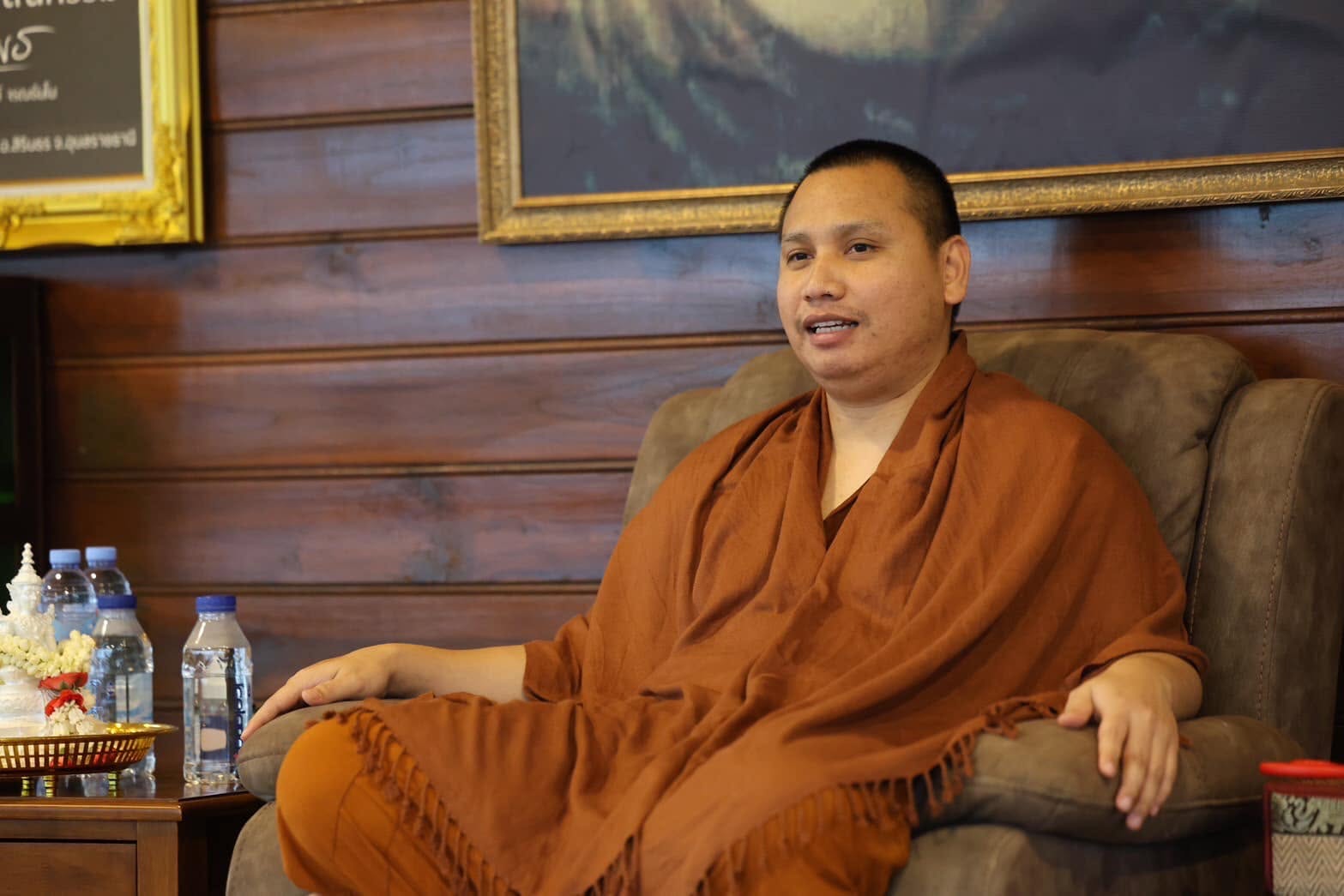
So I was watching a Dhamma talk from Ajahn Tawan this week, and I have to share it with you.
Ajahn Tawan (Phra Ajarn Tawan Panyawatthako) is a Thai forest monk from Tham Chaeng monastery in Lampang, northern Thailand. On 14 October 2026 he sat with a room of schoolchildren at a practice centre in Nakhon Si Thammarat, in the south of Thailand. These kids were the third group of his Kla Tawan programme, five days of living together from 5am, meditating, and writing an essay on the hardships of their parents and their gratitude.
That night he told the adults to stay quiet, and he let the children ask him anything they wanted for fifty minutes.
What incredible questions these children are asking. So simple, yet so profound. Here are some of them. He speaks in Thai, so his answers below come from a translation and are close, not word for word.
"Why do people have to have love and hate?"
This was the very first question.
Ajahn Tawan said love and hate are just human nature, like asking why we have five fingers. The real question is not why we feel them, it is whether we can stay balanced inside them.
Then he gave the children a picture. Three things fall into a stream:
- A dry leaf. It goes wherever the water takes it. Whatever emotion comes up, it follows completely.
- A coconut. Sometimes it sinks, sometimes it floats. That is most of us. We become fully present in a crisis, like seeing an accident or a snake, and then we get home and drift off again.
- A stone. It sinks and stays. It watches the water move over it. That is the person who has trained their mind.
His advice: "Don't trust your emotions 100%." When you are happy, don't get carried away. When you are suffering, be balanced in your suffering.
"When we do good and no one praises us, how do we keep wanting to do good?"
If we need someone to see it, he said, then it isn't pure yet. Real goodness knows its own value. You fold your bed sheet in the morning because it is yours to fold, not because someone is checking.
Then he went deeper. The starting point of all learning, he said, is being honest with your own feelings. When we lie to ourselves, we end up disguising ourselves just to be accepted by society, and then we have to carry that identity everywhere. He compared it to a tree where we spend all our time pruning the branches, until the tree is about to die, and forget that a tree grows from its roots.
A child asked how to keep doing good, and he answered with how a false self gets built.
"If we die, where will we go?"
"That is a question that is very easy to answer," he said. "They will definitely take us to the temple."
Everyone laughed. Then he explained it. Our body goes back to the four elements of earth, water, fire and wind. Where we go after that depends on what we did while we were alive, and that is why people fear death. Those who have lived well know where they are going, so they don't live carelessly.
The same boy came back later and asked, if we go to heaven, can we be reborn? Yes, he said. Heaven runs out when the merit runs out. The only way out of the cycle is to wake up.
"Have you ever suffered since becoming a monk?"
He didn't hide behind the robe. He said yes, he has suffered, "to the point where there was no place left for me," and that it started long before he was ordained.
Then he showed the children their own suffering, the kind we don't notice. We are hungry, so we eat. We can't sit still, so we shift. Changing posture, he said, is just avoiding suffering. The poor suffer as the poor, the rich suffer as the rich.
What changed when he became a monk is that he learned how to live with it. Once he began to accept the suffering, it started to unravel.
A little girl then asked him what he does when his legs hurt in meditation. "Endure first," he said. "When I can't take it anymore, I shift my position too."
"If someone hurts us and we let it go, will we be happier?"
Only if you can truly forgive, he said, otherwise the suffering just hides in your heart. Then he gave three kinds of forgiveness:
- Forgiving those above you, like your parents or your boss. That is necessity.
- Forgiving your equals, like a friend or a partner. That comes with conditions, making amends and reconciling.
- Forgiving those below you. That is the highest forgiveness, and the hardest, because your heart has to be genuinely above the person who hurt you.
"Are there still enlightened beings today?"
The last question of the night.
"Definitely, one million percent. A short question gets a short answer."
Why this matters to me
At the end he thanked the children and said, "I have also learned from the things you asked."
In all honesty, the answers Ajahn Tawan gives are so beautiful that they make me feel less equipped to answer questions like these, and they make me want to hand over guidance to the real masters.
And these are the beings that we want to be. Creating our reality.
Questions
Who is Ajahn Tawan?
Phra Ajarn Tawan Panyawatthako is a Thai Buddhist forest monk based at Tham Chaeng monastery (Samnak Song Tham Chaeng) in Lampang, Thailand. He teaches meditation and runs the Kla Tawan programme for children.
What is the Kla Tawan programme?
A five-day live-in programme for Thai schoolchildren with Ajahn Tawan: living together from 5am, mindfulness and meditation, an essay on gratitude to their parents, and prizes and scholarships on the last day. October 2026 was its third intake.
What did Ajahn Tawan teach about emotions?
That people are like a dry leaf, a coconut or a stone falling into a stream. Training the mind makes you the stone, able to watch your emotions without being carried away by them.
What did Ajahn Tawan say about forgiveness?
That there are three kinds: forgiving those above you (necessity), your equals (with conditions) and those below you (the highest and hardest).
Where can I watch the talk?
On YouTube: youtube.com/watch?v=5HbunjKDZpc. It is in Thai, and YouTube's auto-translated English captions carry most of it.