
Do you have a calling?
Are you looking for yourself?
Henosis is founded upon the idea that every human being in unique and has a purpose. You have aspects that make you so different to every other human on the planet, yet such deep similarities that show we're all the same.
Origin Story of Henosis
The Greek word henosis refers to the process of achieving a state of oneness or unity with the divine. This concept has been central to many mystical and philosophical traditions throughout history, particularly in ancient Greece.
The term henosis comes from the Greek word ἕνωσις, which means "union" or "merging." It was used by several ancient Greek philosophers, including Plotinus and Proclus, to describe the goal of mystical practice.
For these philosophers, the goal of mystical practice was to transcend the limitations of the physical world and achieve a direct experience of the divine.
This experience was seen as a merging or union with the divine, a state of consciousness in which the individual and the divine were no longer separate entities but were united as one.
In some mystical traditions, henosis was seen as a gradual process of spiritual development, in which the individual gradually purifies their mind and body and becomes more attuned to the divine. In others, it was seen as a sudden, spontaneous experience that could occur at any time.
The concept of henosis was also central to many ancient Greek religious practices, particularly in the mystery religions. These were secretive, initiatory cultures that focused on the direct experience of the divine through ritual practices, often involving ecstatic states of consciousness.
Henosis has also been an important concept in the history of Christianity, particularly in the Eastern Orthodox tradition. In this tradition, henosis is seen as the ultimate goal of spiritual practice, a state of union with God that is achieved through prayer, contemplation, and asceticism.
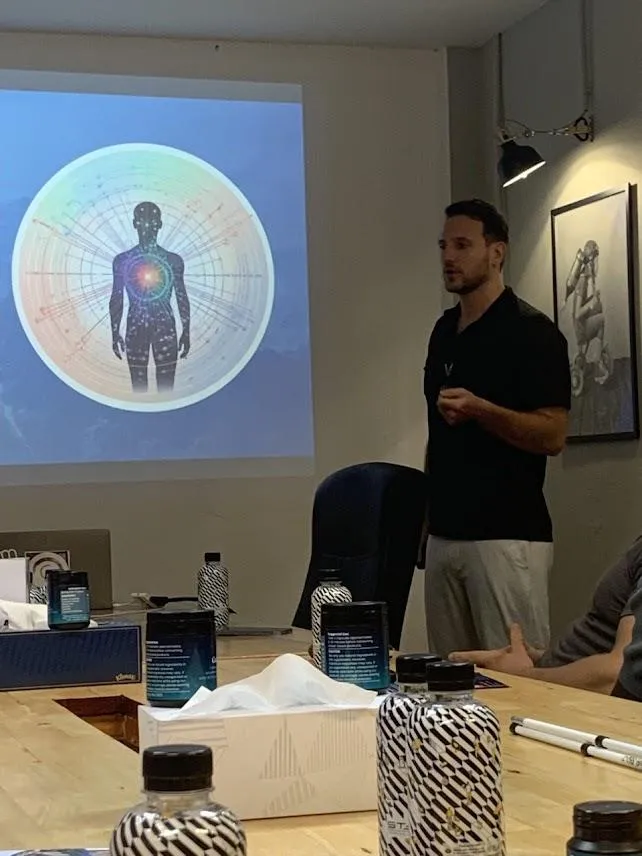
Overall, the concept of henosis is a complex and multifaceted one that has played a central role in many mystical and philosophical traditions throughout history. Whether seen as a gradual process of spiritual development or a sudden, spontaneous experience, it represents the human longing for a direct experience of the divine, and the recognition that this experience lies at the heart of our deepest aspirations and desires.

HENOSIS PURPOSE
Henosis was formed to hold space for the lost soul, questioning their current reality, and to provide alternative information and experiences that may serve as the launching pad for their new life.

HENOSIS VISION
We believe that all humans deserve to live a life of fulfillment and to participate in the raising of the vibrational frequency of earth to expand consciousness.

HENOSIS MISSION
Henosis assists with the shedding of our limiting beliefs, overcoming our emotional and energetic blocks and reprogramming harmful habits and biases. We develop educational information, events and activities to promote ancient wisdom, alternative medicines, new age science and holistic healing modalities to empower the individual to discover their own limitless possibilities and increase awareness.
What the greats say about Henosis over Millenia
Within the word henosis lies a powerful invitation to experience the unity and oneness that exists within and around us, to dissolve the illusion of separateness and awaken to the truth of our interconnectedness with all of life.
Plato
Henosis is the transcendence of the self, the merging of the individual with the divine, and the attainment of spiritual enlightenment.
Eckhart Tolle
The experience of henosis is a mystical journey, a quest for the ultimate truth and the ultimate reality.
Carl Jung
In the state of henosis, the individual ego dissolves into the infinite, and the soul merges with the divine.
Deepak Chopra
Henosis is the realisation that we are all interconnected, that we are all part of a greater whole, and that we are all one.
Alan Watts
In the state of henosis, the boundaries between self and other dissolve, and the individual becomes one with the universe and all that exists.
Sri Ramana Maharshi
Henosis is the state of being in which one transcends the limitations of the ego and realises the true nature of the self as part of the divine.
Buddha
Henosis is the ultimate liberation, the release from the bonds of the ego and the attainment of eternal bliss and peace.
Henosis
Henosis represents the journey of transcending individuality, merging with the divine, and awakening to the unity that connects all of existence.
Interested in changing your life?
Check out some of our free articles
HEALTH & WELLBEING
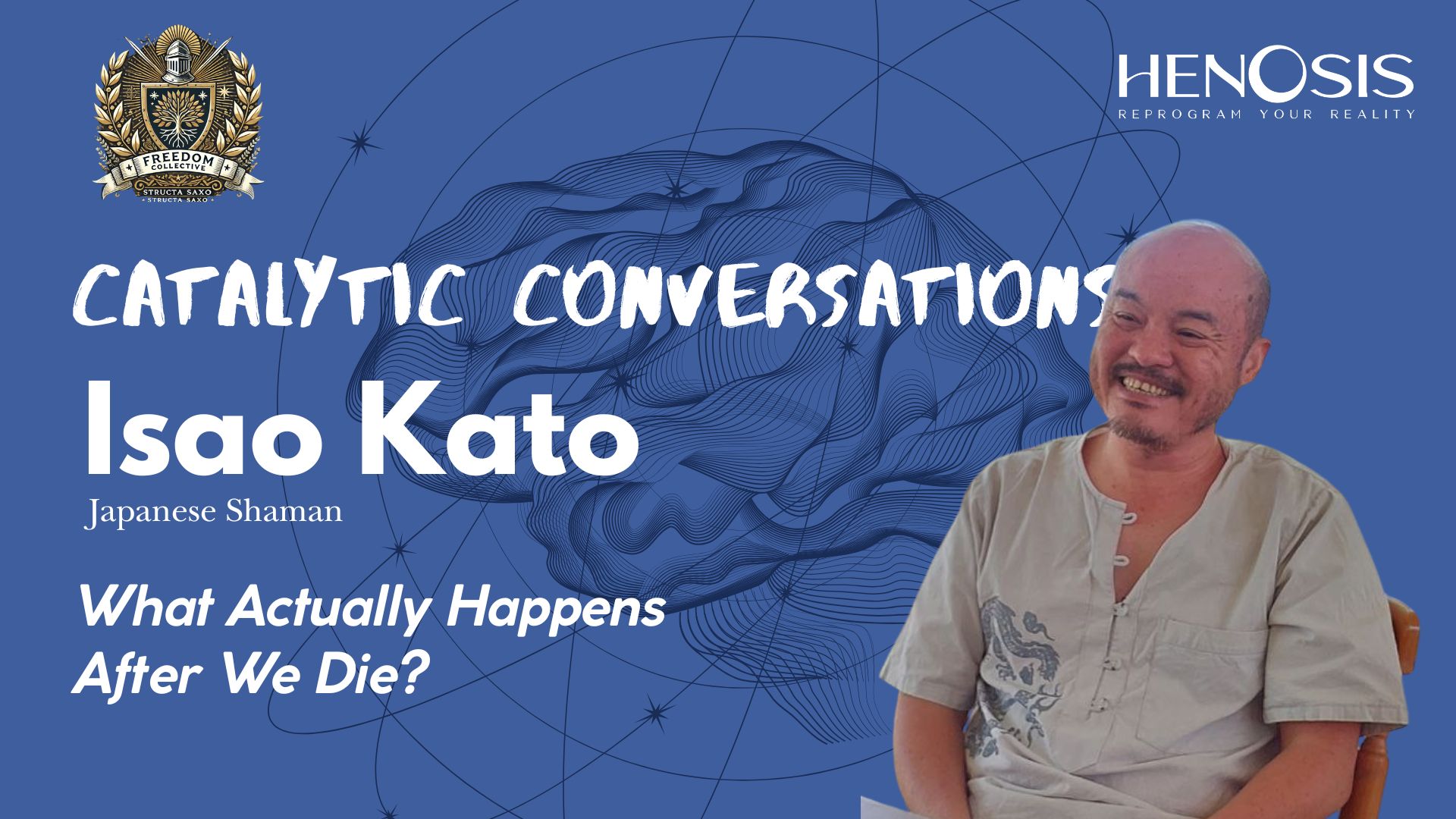
What Happens After We Die? A Conversation That Changed How I See Everything
There are conversations that inform you, and then there are conversations that restructure something inside you. Our session with Japanese shaman Isao Kato was the latter.
I’ve never heard someone speak about death, suicide, entities, and the invisible layers of our reality with such clarity, simplicity, and groundedness. These are topics people normally avoid, either out of fear or misunderstanding and yet the way Isao described everything made it feel surprisingly logical. Almost obvious. As if he wasn’t teaching something mystical, but simply pointing out a world that has always been there.
What stayed with me the most was Isao’s framing of death as “waking from a dream.” Not an ending, not a tragedy, not a punishment but a transition into a state that is actually more real than the physical world we cling to. The idea that some souls pass through cleanly while others loop due to unfinished business offered a compassionate, non-dramatic view of what we often fear the most.

His explanation of suicide was equally striking. Not moralized. Not romanticized. Just honest. Some souls leave early. Some struggle. Some drift. But regret, he reminded us, is not a soul-based emotion it belongs to the human experience. That alone lifted so much heaviness from a topic that carries so much silence.
The distinction between the upper, middle, and lower worlds was another moment of clarity. Understanding that the upper and lower worlds are benevolent realms while the middle world, our world, is the unpredictable one suddenly made the entire cosmology make sense. It framed the unseen not as something to fear, but as something to understand.
But perhaps the most grounding moment was when he spoke about entity attachments. Instead of making it spooky or sensational, he broke it down into something incredibly simple: frequency. Resonance. Mismatch. Hygiene.
No fear. No theatrics. Just clarity.
And it was his point about spiritual hygiene beginning with the physical body that tied it all together. Before we cleanse energies, patterns, or histories, we tend to the vessel. The human part. The grounded part. The place where spirit meets matter.
As I sat with all of this afterward, what surprised me most was how normal everything felt.

Not strange.
Not unbelievable.
Just… true.
It made me realize that the unseen world isn’t separate from us, it’s woven into our daily lives, our emotions, our experiences, our pain, and our healing. And conversations like this help bring those threads into the light.
There’s something powerful about hearing someone speak the truth of their experience with no need for performance or persuasion.
Just clarity.
Just presence.
Just truth.
I walked away feeling less afraid of death, more curious about life, and more aware of the invisible structures that shape what we call reality. And if this conversation did anything, it reminded me that understanding the unseen doesn’t pull us away from life, it actually roots us deeper into it.
PSYCHOLOGY
What Happens After We Die? A Conversation That Changed How I See Everything
There are conversations that inform you, and then there are conversations that restructure something inside you. Our session with Japanese shaman Isao Kato was the latter.
I’ve never heard someone speak about death, suicide, entities, and the invisible layers of our reality with such clarity, simplicity, and groundedness. These are topics people normally avoid, either out of fear or misunderstanding and yet the way Isao described everything made it feel surprisingly logical. Almost obvious. As if he wasn’t teaching something mystical, but simply pointing out a world that has always been there.
What stayed with me the most was Isao’s framing of death as “waking from a dream.” Not an ending, not a tragedy, not a punishment but a transition into a state that is actually more real than the physical world we cling to. The idea that some souls pass through cleanly while others loop due to unfinished business offered a compassionate, non-dramatic view of what we often fear the most.
His explanation of suicide was equally striking. Not moralized. Not romanticized. Just honest. Some souls leave early. Some struggle. Some drift. But regret, he reminded us, is not a soul-based emotion it belongs to the human experience. That alone lifted so much heaviness from a topic that carries so much silence.
The distinction between the upper, middle, and lower worlds was another moment of clarity. Understanding that the upper and lower worlds are benevolent realms while the middle world, our world, is the unpredictable one suddenly made the entire cosmology make sense. It framed the unseen not as something to fear, but as something to understand.
But perhaps the most grounding moment was when he spoke about entity attachments. Instead of making it spooky or sensational, he broke it down into something incredibly simple: frequency. Resonance. Mismatch. Hygiene.
No fear. No theatrics. Just clarity.
And it was his point about spiritual hygiene beginning with the physical body that tied it all together. Before we cleanse energies, patterns, or histories, we tend to the vessel. The human part. The grounded part. The place where spirit meets matter.
As I sat with all of this afterward, what surprised me most was how normal everything felt.
Not strange.
Not unbelievable.
Just… true.
It made me realize that the unseen world isn’t separate from us, it’s woven into our daily lives, our emotions, our experiences, our pain, and our healing. And conversations like this help bring those threads into the light.
There’s something powerful about hearing someone speak the truth of their experience with no need for performance or persuasion.
Just clarity.
Just presence.
Just truth.
I walked away feeling less afraid of death, more curious about life, and more aware of the invisible structures that shape what we call reality. And if this conversation did anything, it reminded me that understanding the unseen doesn’t pull us away from life, it actually roots us deeper into it.
HAPPINESS
What Happens After We Die? A Conversation That Changed How I See Everything
There are conversations that inform you, and then there are conversations that restructure something inside you. Our session with Japanese shaman Isao Kato was the latter.
I’ve never heard someone speak about death, suicide, entities, and the invisible layers of our reality with such clarity, simplicity, and groundedness. These are topics people normally avoid, either out of fear or misunderstanding and yet the way Isao described everything made it feel surprisingly logical. Almost obvious. As if he wasn’t teaching something mystical, but simply pointing out a world that has always been there.
What stayed with me the most was Isao’s framing of death as “waking from a dream.” Not an ending, not a tragedy, not a punishment but a transition into a state that is actually more real than the physical world we cling to. The idea that some souls pass through cleanly while others loop due to unfinished business offered a compassionate, non-dramatic view of what we often fear the most.
His explanation of suicide was equally striking. Not moralized. Not romanticized. Just honest. Some souls leave early. Some struggle. Some drift. But regret, he reminded us, is not a soul-based emotion it belongs to the human experience. That alone lifted so much heaviness from a topic that carries so much silence.
The distinction between the upper, middle, and lower worlds was another moment of clarity. Understanding that the upper and lower worlds are benevolent realms while the middle world, our world, is the unpredictable one suddenly made the entire cosmology make sense. It framed the unseen not as something to fear, but as something to understand.
But perhaps the most grounding moment was when he spoke about entity attachments. Instead of making it spooky or sensational, he broke it down into something incredibly simple: frequency. Resonance. Mismatch. Hygiene.
No fear. No theatrics. Just clarity.
And it was his point about spiritual hygiene beginning with the physical body that tied it all together. Before we cleanse energies, patterns, or histories, we tend to the vessel. The human part. The grounded part. The place where spirit meets matter.
As I sat with all of this afterward, what surprised me most was how normal everything felt.
Not strange.
Not unbelievable.
Just… true.
It made me realize that the unseen world isn’t separate from us, it’s woven into our daily lives, our emotions, our experiences, our pain, and our healing. And conversations like this help bring those threads into the light.
There’s something powerful about hearing someone speak the truth of their experience with no need for performance or persuasion.
Just clarity.
Just presence.
Just truth.
I walked away feeling less afraid of death, more curious about life, and more aware of the invisible structures that shape what we call reality. And if this conversation did anything, it reminded me that understanding the unseen doesn’t pull us away from life, it actually roots us deeper into it.
What is Henosis?
Henosis is a transformative coaching and experience platform that offers globally immersive consciousness-expanding experiences, coaching systems, and therapies designed to foster personal growth and profound transformation.
Who can benefit from Henosis services?
Henosis serves individuals seeking deeper clarity, fulfillment, and purpose, whether they’re navigating personal challenges, embarking on spiritual journeys, or simply aiming to grow beyond conventional achievements.
What is the DeProgram + ReProgram Coaching System?
The DeProgram + ReProgram System is a 12-month transformative coaching program that guides participants through dismantling limiting behaviors, uncovering blind spots, and cultivating habits aligned with their authentic selves.
How does Henosis integrate spirituality into its coaching?
Henosis combines insights from psychology, ancient wisdom, and modern technology, offering a holistic approach that helps individuals connect with their purpose and inner clarity.
Is Henosis' approach evidence-based?
Yes, Henosis blends science-backed coaching methodologies with ancient wisdom practices, creating a balanced and effective approach to personal transformation.
Subscribe to our Newsletter
USEFULL LINKS
ARTICLE CATEGORIES
EVERYTHING WE DO
SOCIAL


Copyright 2026. Henosis. All Rights Reserved.